Insulating your walls is one of the most effective ways to make a home warmer and cheaper to run, but the right approach depends entirely on how your walls are built. Cavity wall insulation and solid wall insulation are not interchangeable — they address different structures, cost very different amounts, and are suited to different eras of housing. Getting the distinction clear before you speak to an installer saves time, sets realistic expectations and helps you understand which grants you may be able to access.
How to Tell Which Type of Wall You Have
The simplest clue is when your home was built. Properties constructed after around 1920 in England and Wales, and into the 1930s in Scotland, were increasingly built with cavity walls — two skins of brick or blockwork separated by a gap of around 50 to 100 mm. Homes built before that era, and a significant number of interwar properties, tend to have solid walls: a single layer of brick or stone with no gap in the middle. The thickness of your external wall is a useful indicator. Measure a window reveal from inside to the exterior face; a solid brick wall is typically around 225 mm or more, whereas a cavity wall tends to be closer to 275 to 300 mm.
Looking at the brickwork from outside is another quick check. Cavity walls usually show a consistent pattern of bricks laid lengthways, known as stretcher bond. Solid walls often alternate rows laid lengthways with rows laid end-on, a pattern called English or Flemish bond, though render or cladding on many older homes makes this harder to see. If you are unsure, an insulation installer can confirm the wall type during a survey — it takes only a small drill hole to check.
How Cavity Wall Insulation Works
If your home has an unfilled cavity, fitting insulation is a relatively quick and minimally disruptive job. An installer drills a pattern of small holes into the external brickwork, injects insulating material — typically mineral wool, expanded polystyrene beads, or polyurethane foam — into the gap, then fills and makes good each hole. The process usually takes a single day or less for a standard semi-detached house, and there is no significant disruption to the interior of your home.
- Work is entirely from outside — rooms remain usable throughout.
- Typical installation takes half a day to one full day.
- Holes drilled are small (around 22 mm) and are filled and colour-matched on completion.
- No loss of internal floor space.
- Generally the most cost-effective wall insulation measure available.
The main caveat is suitability. Not every cavity can be filled. Walls exposed to driving rain, particularly in parts of Scotland, Wales and the western coast of England, may not be appropriate for standard cavity fill because there is a risk of moisture bridging the cavity and causing dampness internally. An installer must assess your exposure zone before recommending a product. Some cavities are also too narrow, or already filled, or contain structural ties that limit options.
How Solid Wall Insulation Works
Solid wall insulation is a more involved undertaking because there is no cavity to fill — insulation has to be added either to the inside face of external walls or to the outside of the building. Both approaches are effective, and the right choice depends on your property's circumstances: whether you have external render or cladding, how much internal space you can afford to lose, the condition of the outside walls, and whether the whole street is being treated together, which can reduce costs for external work.
Internal wall insulation (IWI) involves fixing insulated boards or a timber frame filled with insulation to the inside of external walls. It is the more common choice for individual properties where external changes are restricted — by planning rules, by a terrace with shared elevations, or by the condition of the outside surface. The trade-off is that each treated wall loses between 75 and 125 mm of floor space, skirting boards and electrical sockets need to be moved, and rooms need to be emptied during installation. It is a more significant building project than cavity fill.
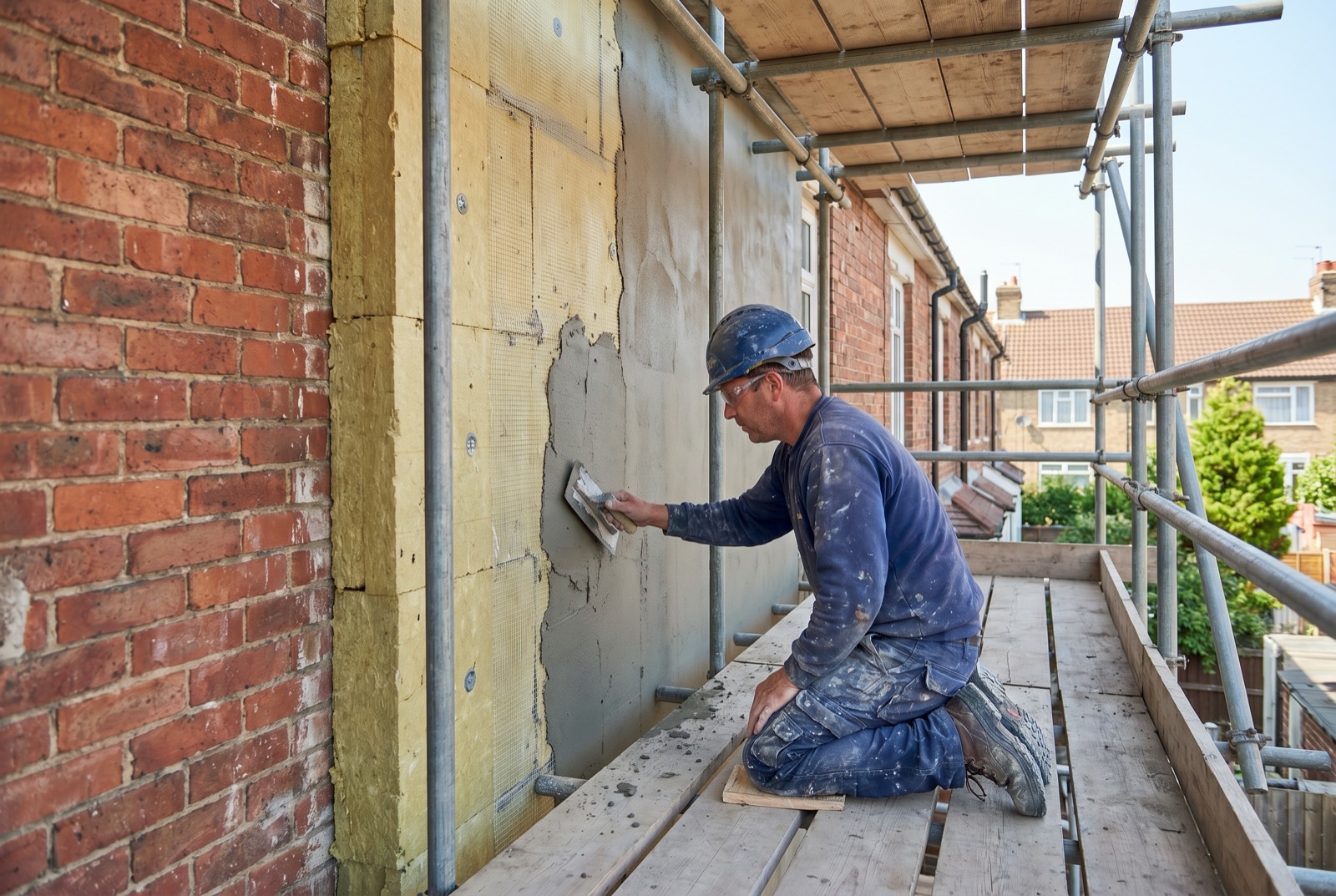
External wall insulation (EWI) wraps insulating boards around the outside of the building and covers them with a new render or cladding system. It does not reduce internal space, and it can refresh the appearance of a building considerably. It is well-suited to mid-terraces where internal access is difficult, to blocks of flats treated as a whole, and to properties where the outside walls are in poor condition and need attention anyway. It does, however, require planning permission in some cases — particularly for listed buildings, homes in conservation areas, and houses in some local authorities — so always check before proceeding.
Typical Costs
The cost difference between cavity wall and solid wall insulation is substantial, and it is important to be clear-eyed about this before comparing options. The points below set out how the two compare; your actual quote will depend on the size of your home, the product specified, the installer and the complexity of the job.
- Cavity wall insulation: the cheaper of the two, and one of the more affordable energy-saving measures overall.
- Internal solid wall insulation: considerably more expensive than cavity, driven by how many walls are treated and the level of making-good required.
- External solid wall insulation: typically the most expensive, driven by the size of the building and the render or cladding system chosen.
- Costs for flats and end-of-terrace properties vary considerably — always get a survey-based quote.
Solid wall insulation represents a significant investment, which is why the grant picture matters considerably more for solid-wall properties than for cavity-wall ones. It is also why, for properties that have both an unfilled cavity and poorly insulated solid walls — a configuration found in some Victorian extensions, for example — the cavity is almost always the sensible starting point.
Which Properties Suit Which Type
Cavity wall insulation suits most post-1920s properties with an unfilled cavity in a location that is not excessively exposed to driving rain. It is particularly suitable for 1930s to 1990s semi-detached and detached homes, where the cavity is accessible and wide enough to accept fill. Before an installation can proceed in England, Wales and Scotland, a technical survey is required to confirm the wall is suitable — a reputable installer will always carry this out.
Solid wall insulation is the only option for pre-1920s solid brick or stone properties, and for many Victorian terraces. Internal insulation is more commonly used in conservation areas, listed buildings, or where planning restrictions prevent external changes. External insulation is better suited to properties where the outside walls need attention anyway, and where the characteristic appearance of the building is not restricted — it is also often more practical for maisonettes and flats treated at block level. A surveyor can advise on which route makes most technical and practical sense for your specific home.
UK Grants and Financial Support
Two main government schemes currently fund wall insulation for qualifying households in England. The Energy Company Obligation (ECO4) requires large energy suppliers to fund energy-efficiency improvements for low-income and vulnerable households. If you receive certain means-tested benefits — including Universal Credit, Pension Credit and others — you may be eligible for fully funded cavity wall or solid wall insulation under ECO4 with no upfront cost to you. The scheme is delivered through energy companies and their approved contractors, and your local council may also be able to point you towards ECO4 funding.
The Great British Insulation Scheme (GBIS) is a broader programme aimed at homes with an EPC rating of D or below. It is open to a wider range of households than ECO4, including some owner-occupiers and private tenants not on benefits, and it primarily targets single insulation measures — cavity wall insulation in particular. Support under GBIS may be full funding or a contribution towards costs depending on your household income and property. Both schemes are administered through energy suppliers and are accessed via the supplier or a local authority referral, not through a direct government application. Scotland and Wales have their own programmes: Home Energy Scotland offers grants and loans for insulation measures, and the Nest scheme in Wales provides free energy-efficiency improvements to eligible households.
Across the UK, qualifying wall insulation measures are currently zero-rated for VAT until 31 March 2027, which means no VAT is charged on the installation. This applies automatically on an installer's invoice for qualifying work — you do not need to claim it separately. Always confirm the latest position on gov.uk, as VAT rules and scheme eligibility criteria can change.
The Impact on Your Home and Heating System
Wall insulation does more than reduce a heating bill. A better-insulated home holds heat for longer, which means rooms warm up faster, stay more comfortable, and your heating system cycles less. For homes considering a heat pump in future — or already running one — good wall insulation is particularly important, because a heat pump works most efficiently in a well-insulated home where it does not need to push out very high flow temperatures to maintain a comfortable temperature. In this sense, wall insulation can be a useful first step before upgrading heating: it lowers the heat demand of the property, which in turn may allow a smaller, cheaper heating system to be specified.
Improving insulation can also have a positive effect on your EPC rating, which matters if you are letting a property (from 2025 England targets EPC E as a minimum for new tenancies), applying for the Boiler Upgrade Scheme (which requires an EPC with no outstanding loft or cavity insulation recommendations), or planning to sell. Addressing the walls is one of the measures most likely to shift an EPC rating upwards.
Getting a Reliable Assessment
Because the right type of insulation, the right product and the right installer matter considerably — and because the consequences of a poorly assessed or fitted job (damp penetration, cold bridging, a failed grant application) are real — it is worth starting with a thorough survey from a qualified installer before committing to anything. The survey should confirm your wall type, assess exposure and suitability, recommend the appropriate approach, and identify which grants you may be eligible for.
Renovation Register lists MCS-certified installers across the UK who cover wall insulation alongside other home-energy measures. If you would like a no-obligation starting point, a free project assessment connects you with an installer who can survey your home, advise on the most suitable approach and help you understand what financial support is available for your property and circumstances. You can find certified installers at /installers or request an assessment at /demande.