Decarbonising a home can feel like an endless list of competing technologies and schemes, each with its own caveats and costs. But there is a logic to the order that makes every step work better — and getting it wrong is an expensive mistake. The sequence that experienced energy assessors return to again and again is straightforward: seal the building first, replace your heating second, generate your own electricity third, and store what you can fourth. This guide explains why that order matters and what each stage involves, in plain terms.
Why the order matters
Each step in the decarbonisation journey feeds the next. Insulation reduces the amount of heat your home loses, which means you need a smaller, cheaper heat pump to keep it warm. A smaller heat pump draws less electricity, which means a more modestly sized solar array can meet more of its demand. A well-sized array, paired with battery storage, lets you use more of your own generation and buy less from the grid. Start at the wrong end — fitting a heat pump into a poorly insulated house, or solar onto a home still heated by a boiler — and you pay more than you should for results that underdeliver.
Step one: insulate first
Insulation is unglamorous, but it is the foundation of everything else. Without it, heat escapes through walls, roofs and floors faster than any heating system can replace it comfortably. The priority areas for most UK homes are loft insulation, cavity wall insulation where the construction allows it, and floor insulation where there is accessible suspended timber. Solid wall insulation — either internal dry-lining or external cladding — is more disruptive and costs more, but for older solid-wall homes it can transform performance.
Insulation also directly unlocks the main heating grant. The Boiler Upgrade Scheme requires a valid Energy Performance Certificate with no outstanding recommendations for loft or cavity wall insulation. Sort those measures out first and you remove the single most common reason applications stall. There are also dedicated schemes to help with costs: the Great British Insulation Scheme and the Energy Company Obligation (ECO4) both provide funded or subsidised insulation for qualifying homes, with eligibility based on EPC rating and income. Insulation and other energy-saving materials are zero-rated for VAT until 31 March 2027, which keeps the out-of-pocket cost lower. Costs vary widely — loft insulation in an accessible roof is one of the cheapest measures, while solid wall insulation is considerably more expensive depending on the approach and property size, so a survey-based quote gives an accurate figure.
Step two: replace your heating
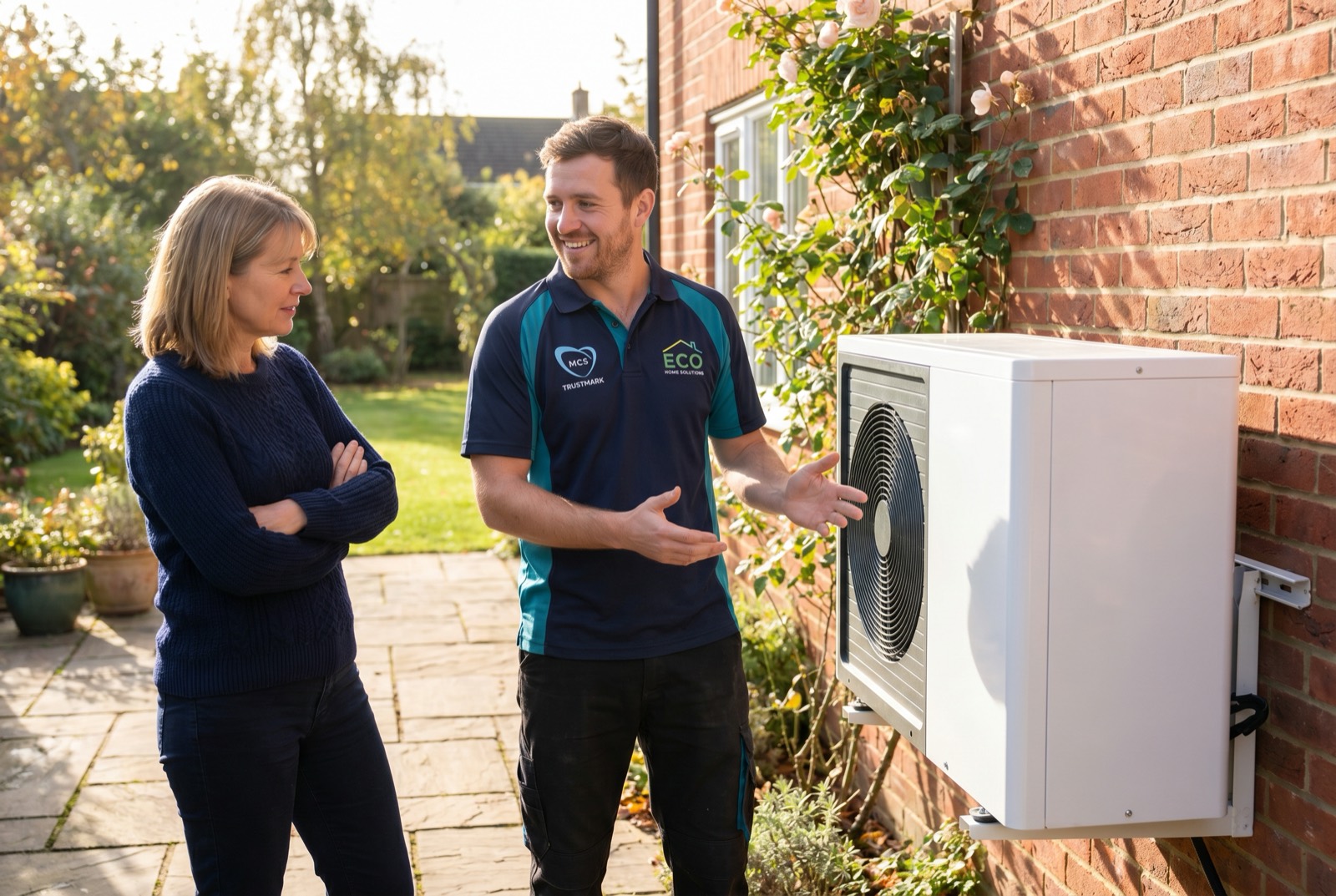
Once the fabric of your home retains heat more effectively, you are in a position to replace your fossil-fuel boiler with a low-carbon alternative. For most UK homes, an air-source heat pump is the practical choice: it extracts heat from outside air and delivers it into your home at a lower, steadier temperature than a boiler would, running most efficiently in a well-insulated building. Ground-source heat pumps offer higher efficiency still but require either boreholes or ground loops, which adds cost and is more involved. Biomass boilers are eligible in rural properties in England and Wales that meet specific conditions.
- Air-source heat pump: the cheaper of the two to install, eligible for up to £7,500 under the Boiler Upgrade Scheme in England and Wales.
- Ground-source heat pump: more expensive to install because of the groundworks, also eligible for up to £7,500 under BUS.
- Biomass boiler: eligible for up to £5,000 under BUS in rural England and Wales, subject to specific conditions.
- All systems are zero-rated for VAT until 31 March 2027.
- Scotland has its own comparable support through Home Energy Scotland grants and loans.
- The BUS grant is applied upfront by your MCS-certified installer — you pay only the balance.
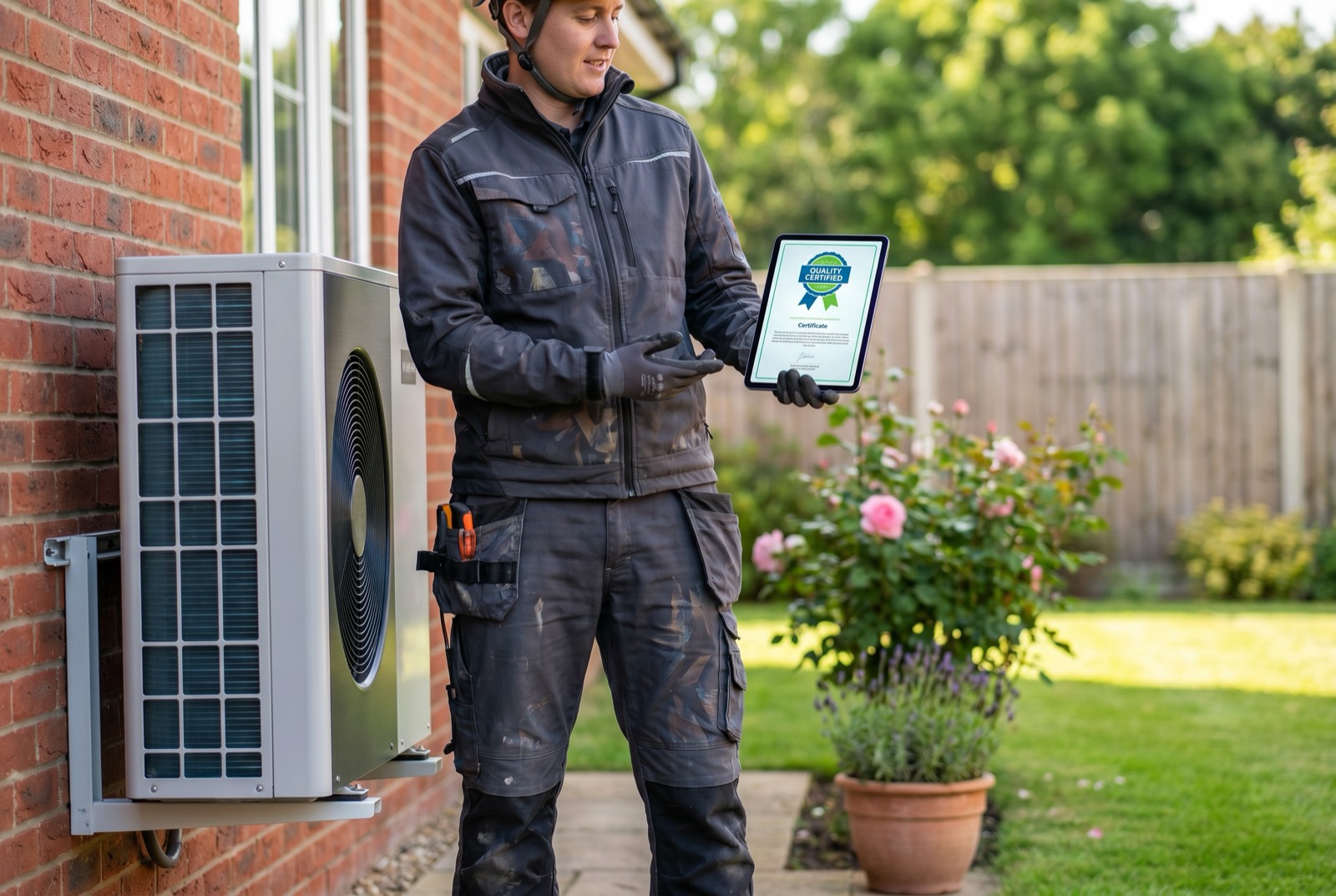
The MCS-certified requirement here is not a technicality. MCS certification is what makes a heat pump installation eligible for the Boiler Upgrade Scheme and for future Smart Export Guarantee payments if you add solar. It also guarantees the installation has been assessed against a recognised quality standard, from system design through to commissioning. You can verify any installer's current certification on the public register at mcscertified.com before you sign anything.
Step three: generate your own electricity
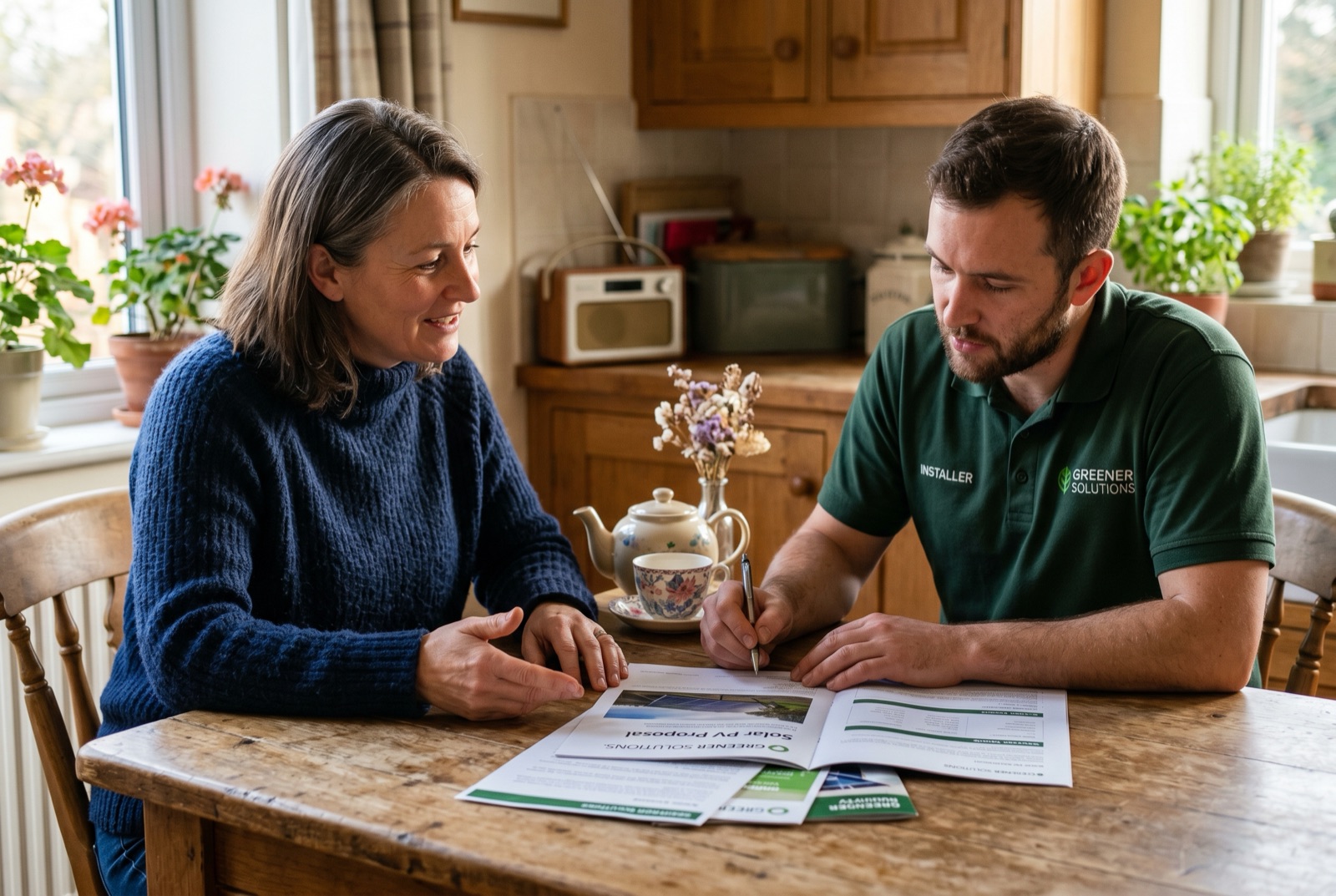
With a well-insulated home and a heat pump in place, you have a low-carbon heating system that runs on electricity. Adding solar PV at this point lets you generate some of that electricity yourself, which directly offsets what you would otherwise buy from your supplier. The economics are strongest when you can use a good proportion of your own generation — to run your heat pump, charge an electric vehicle, or power everyday appliances during daylight hours.
A 3 to 5 kWp solar PV system is zero-rated for VAT until 31 March 2027, with the install cost driven mainly by system size and roof complexity. Any surplus electricity you export to the grid is eligible for payment through the Smart Export Guarantee, provided your installation is MCS-certified and you have a compatible export meter. SEG rates vary between suppliers and change over time, so it is worth comparing current tariffs rather than relying on older figures. South-, east- and west-facing roofs all work; shading from trees or chimneys reduces output meaningfully and should be assessed during a survey.
Step four: store what you generate
Solar panels produce most of their electricity during the middle of the day, when many households are using relatively little power. Without storage, that surplus is exported to the grid for a modest return through the Smart Export Guarantee. A home battery captures it instead, holding it until the evening when your household demand is higher and grid electricity is more expensive. For homes on a time-of-use tariff, a battery can also charge from cheap overnight electricity, displacing expensive peak-rate imports.
Battery storage install costs are driven mainly by capacity, and it is zero-rated for VAT until 31 March 2027 — including retrofitted batteries added to an existing solar array, not only new combined installations. Whether a battery makes financial sense depends on your usage pattern, your tariff and how large your solar array is relative to your consumption. It is genuinely not the right step for every home, and a good installer should tell you honestly whether it improves your return or adds cost without proportionate benefit.
What to do if you cannot follow the sequence exactly
Real homes have real constraints. You may already have solar fitted but no heat pump. Your landlord may have installed insulation but you cannot touch the heating. You may be replacing a failed boiler under time pressure, before the fabric of the building is ideal. None of these situations means the roadmap is worthless — it means applying the principles with judgment. A boiler replacement in a poorly insulated home can still be done responsibly if you choose a heat pump sized conservatively and commit to the insulation as a follow-on project. Solar already installed is still worthwhile when you add a heat pump later; the combination works, just less optimally than if the heat pump came first. The sequence is a guide to the best use of your money, not a rigid rule that prevents progress in any other order.
The role of a home energy assessment
Reading a roadmap is a different thing from knowing what it means for your specific house. A 1930s semi with uninsulated cavity walls and single-glazed windows has a very different starting point from a 2010 new-build that already exceeds Part L. The right size of heat pump, the right amount of insulation, whether you need to upsize radiators, and whether your roof suits solar all depend on someone looking at your actual home. An energy assessment turns the general roadmap into a prioritised action plan with realistic costs and accurate grant entitlements.
If you would like to understand exactly where your home sits on this roadmap — and what the next step should be — a free project assessment worth £380 is available through Renovation Register. An MCS-certified installer visits your property, surveys it properly and gives you a written recommendation with no obligation. You can request yours at /demande, or find MCS-certified installers near you at /installers.