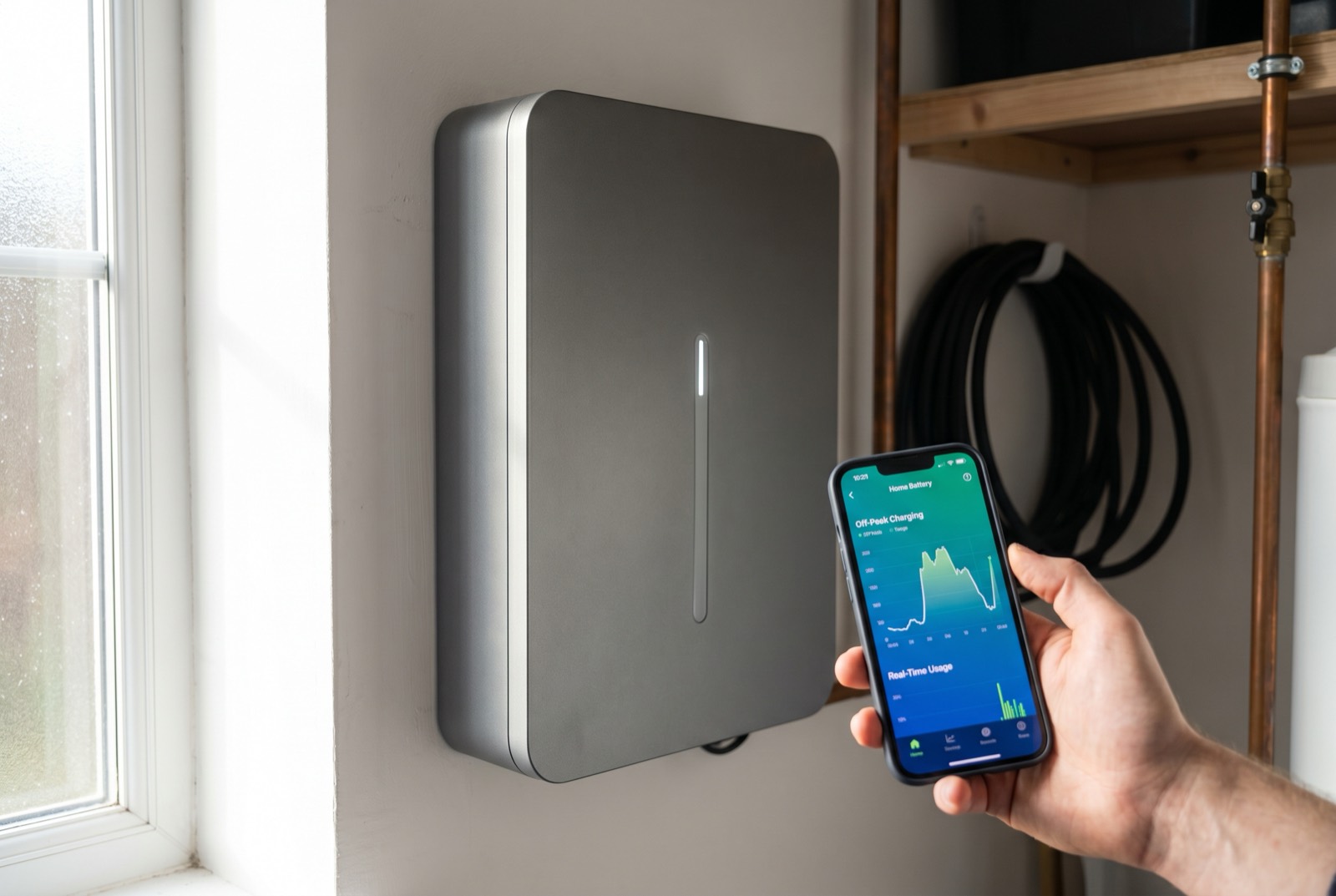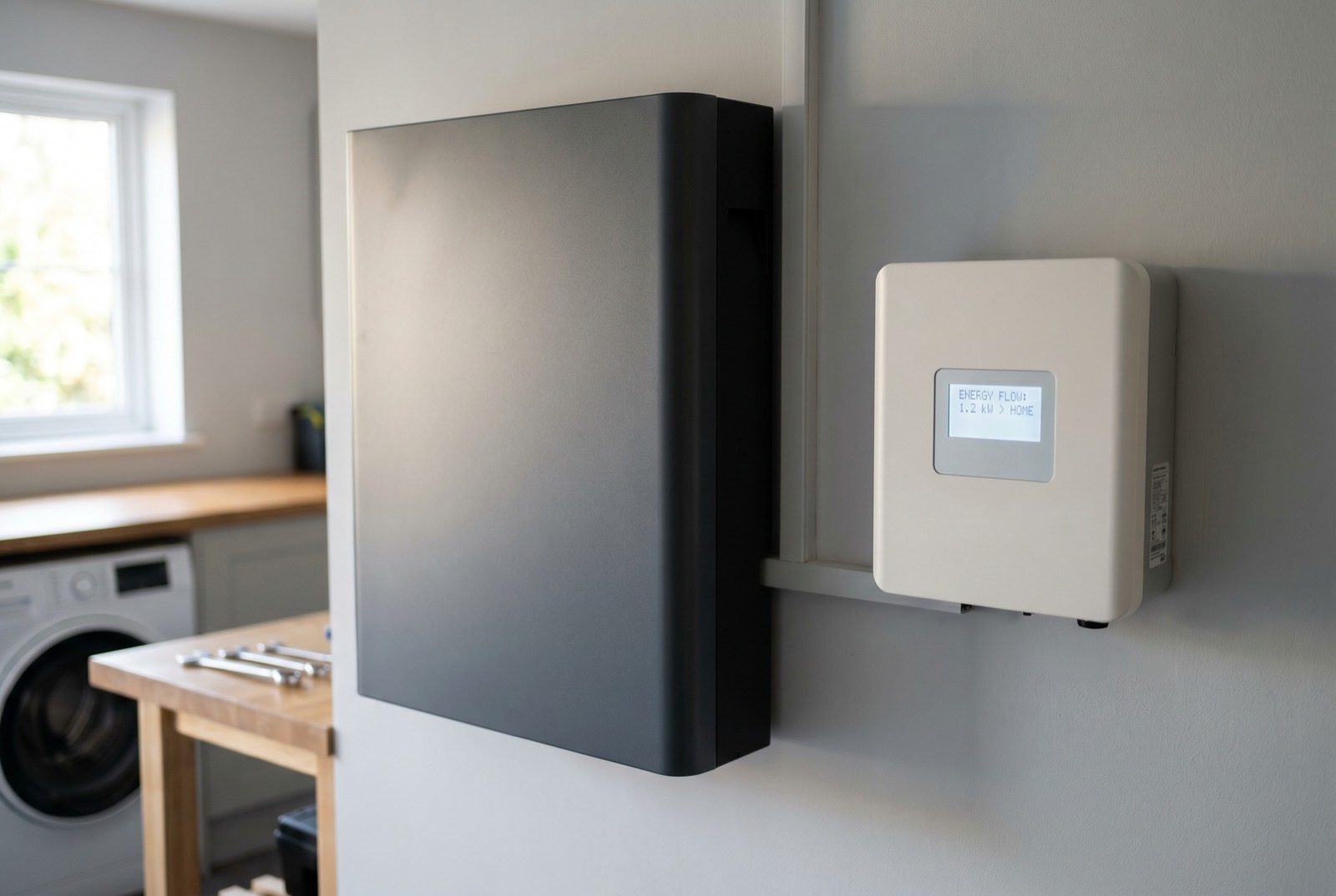
Home battery storage has moved from a niche technology to a mainstream option in the last few years, driven by high electricity prices and falling hardware costs. The core idea is simple: store cheap electricity when the grid has a surplus, use it when prices are high, and reduce what you export to the grid for next to nothing. Whether that trade-off pays off financially depends on the size of your system, the tariff you are on, and whether you already have solar panels. This guide works through the numbers honestly so you can decide whether a battery makes sense for your home.
How a Home Battery Actually Saves You Money
A home battery earns its keep through arbitrage — buying (or storing) electricity at a low rate and consuming it when the grid rate is high. There are two main routes to savings. First, if you have solar panels, a battery captures the generation that would otherwise be exported, typically paying you only a few pence per kilowatt-hour under the Smart Export Guarantee, and lets you use it in the evening when you would otherwise pay the full unit rate. Second, if you are on a time-of-use tariff such as Octopus Go or Intelligent Octopus, you can charge the battery overnight at a cheap off-peak rate — currently ranging from around 7p to 10p per kWh depending on tariff and supplier — and discharge it during peak hours when the standard rate can be 25p to 35p per kWh or higher.
The bigger the spread between your cheap rate and your standard rate, the faster the payback. Households without solar but on a good time-of-use tariff can still achieve meaningful savings, though the maths is tighter. The most compelling case combines both: solar generation stored during the day, topped up cheaply overnight, and used throughout the day and evening to minimise grid imports almost entirely.
What Does a Home Battery System Cost?
Battery storage is sold by usable capacity, measured in kilowatt-hours (kWh). An entry-level system of around 5 kWh covers a typical evening's demand and is the cheapest to install. Mid-range systems of 10 kWh, which most households with solar panels find more useful, cost more. Larger stacked systems of 15–20 kWh, suited to bigger homes or those with an electric vehicle or heat pump, are the most expensive, scaling with the extra capacity. The figure also varies with brand, installation complexity, and whether the battery is being added to an existing solar installation or fitted as a standalone system, so an accurate price comes from a quote.
- 5 kWh system: the lowest-cost option to install
- 10 kWh system: costs more than a 5 kWh system
- 15–20 kWh system: the most expensive, scaling with capacity
- Standalone battery (no solar): generally cheaper than a comparable solar-paired install
- Retrofit to existing solar: may involve additional inverter or gateway costs
VAT on Battery Storage
Battery storage systems installed in UK homes currently attract 0% VAT when they are installed alongside a qualifying energy-saving technology such as solar panels, or when they are part of a system primarily intended to store electricity from renewable sources on the same property. HMRC guidance on this has evolved, and the zero-rate position for standalone batteries has at times been less clear-cut, so it is worth asking your installer to confirm the VAT treatment that applies to your specific quote. Where zero-rate VAT does apply, it represents a saving of 20% compared with a standard-rated supply.
Choosing the Right Tariff to Maximise Savings
The tariff you are on has a larger effect on payback than almost any hardware choice. A standard flat-rate tariff gives a battery no room to arbitrage, so you only gain from storing your own solar. Time-of-use tariffs, by contrast, create a meaningful price spread across the day. When evaluating tariffs, look at three numbers: the off-peak unit rate (when you will charge), the peak unit rate (when you will discharge), and whether the tariff has any smart-charging integration that automates the cycle. Some suppliers offer tariffs specifically designed for battery owners, with very cheap overnight windows and automated dispatch. Switching to the right tariff is free and can reduce payback time significantly — sometimes by several years.
- Flat-rate tariff: battery saves only on solar self-consumption, no arbitrage benefit
- Time-of-use tariff (e.g. off-peak overnight): cheap-rate charging enables daily arbitrage
- EV or battery-specific tariffs: may include very low overnight rates, sometimes with smart dispatch
- Export rate under Smart Export Guarantee: typically 4p–15p per kWh depending on supplier
- Check whether your tariff allows half-hourly settlement — required for some advanced battery programmes
How to Size a Battery for Your Home
The right size depends on what you are trying to achieve. If the goal is to self-consume as much solar generation as possible, a useful starting point is your average evening and night consumption — the energy you use between sunset and sunrise. For many UK households this is roughly 5–8 kWh, which points to a 5–10 kWh battery. If you also want to take advantage of overnight cheap-rate charging, add your expected morning and daytime demand on top, which can push the useful size to 10–15 kWh. Oversizing is wasteful — an undersized battery that fills and empties every day earns its keep; a battery that is never fully discharged does not. A good installer will analyse your actual consumption data, ideally from a smart meter or monitoring app, before recommending a size.
Realistic Payback Periods
Payback on a home battery is slower than on solar panels alone, and the honest answer is that it varies considerably. For a household with existing solar panels switching to a time-of-use tariff, annual savings of £300–£700 are commonly cited by installers and energy analysts, though individual results differ. At those savings rates, a typical system pays back in roughly 6–13 years — within, but towards the limit of, a typical 10-year warranty cycle. For a standalone battery with no solar, relying only on tariff arbitrage, the payback is generally longer and depends heavily on how the price spread between peak and off-peak rates develops. Energy prices are not static, and most scenarios assume some real-terms increase over time, which helps battery economics.
Beyond pure payback, batteries provide resilience value that does not show up in a simple financial calculation: stored power during short outages, reduced reliance on volatile wholesale prices, and the ability to participate in emerging grid flexibility programmes, where some suppliers pay households to discharge stored energy at times of grid stress. These programmes are still developing in the UK but represent a potential additional revenue stream in the coming years.
What to Check Before You Buy
- MCS certification: ensure your installer holds MCS accreditation — required to access certain grid connection processes and strongly recommended for quality assurance
- Battery chemistry: lithium iron phosphate (LFP) is now the dominant chemistry for home storage, with a good safety and longevity record
- Warranty terms: check the guaranteed minimum capacity at end of warranty period (typically 10 years at 70% or better)
- Inverter compatibility: if you have an existing solar inverter, confirm the battery is compatible or budget for a hybrid inverter
- Grid connection: larger systems may require a G99 application to your Distribution Network Operator, which adds time and a small cost
- Monitoring software: a good battery system comes with an app showing charge state, savings and generation data in real time
The best way to get a reliable answer for your specific home is to have an MCS-certified installer review your energy bills, smart meter data, and existing generation equipment before quoting. A professional assessment will size the system correctly, confirm the most suitable tariff, and give you a written savings estimate based on your actual consumption profile — at no cost and no obligation. You can find MCS-certified battery storage installers near you through the Renovation Register directory.
Related on Renovation Register