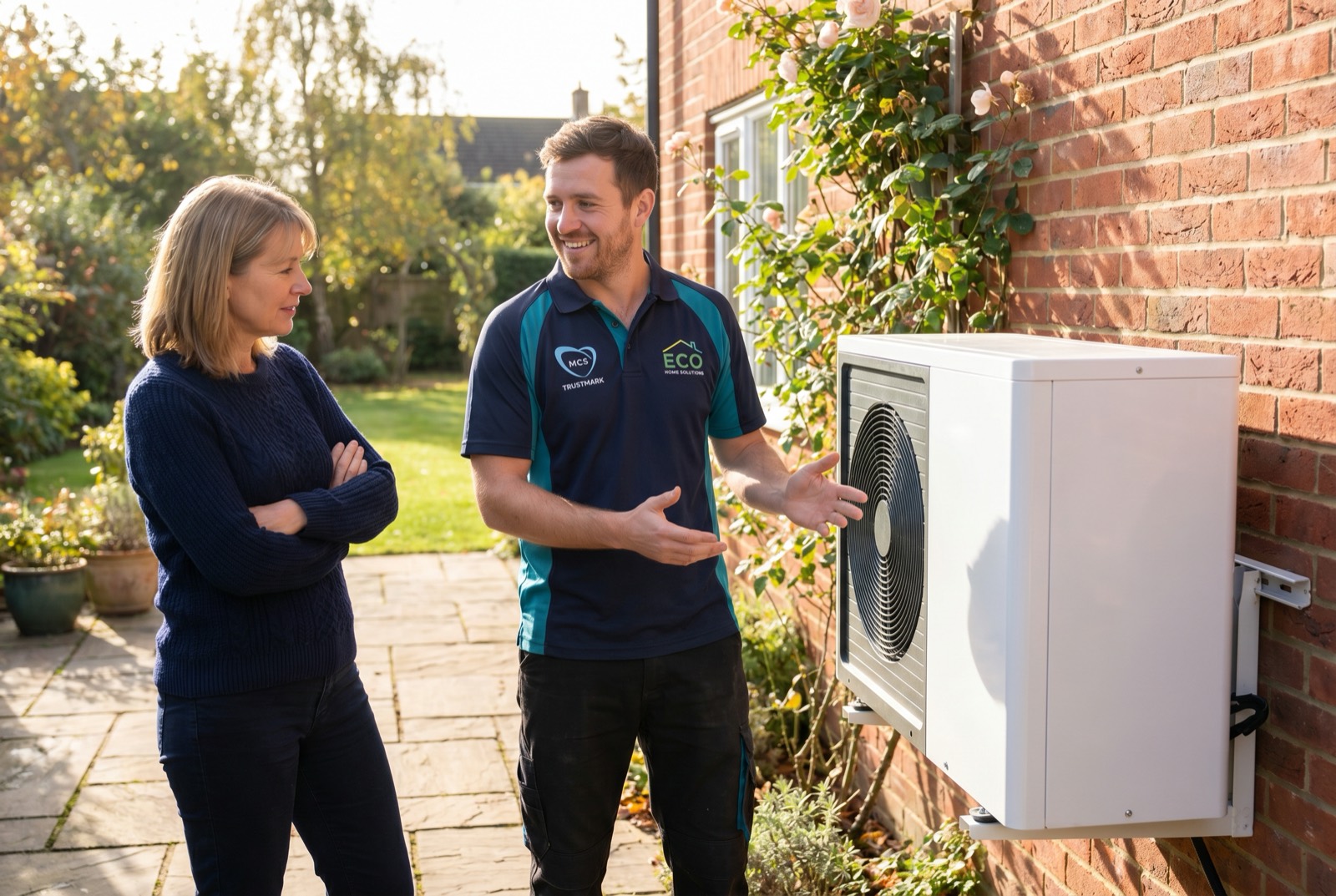
A heat pump is one of the most significant investments a UK homeowner can make, and every system is quoted against your specific property before any grant funding is applied. Done well, it can cut your heating bills and your carbon footprint for two decades. Done poorly, it can underperform, void your warranty, and disqualify you from the government's Boiler Upgrade Scheme. The single biggest variable is the quality of your installer. This guide gives you a practical MCS checklist, the questions that separate good installers from great ones, and the warning signs that should make you walk away.
Why MCS Certification Is Non-Negotiable
MCS — the Microgeneration Certification Scheme — is the UK's quality standard for small-scale renewable energy installations. It covers both the product and the installer. An MCS-certified installer must follow defined design and installation procedures, hold appropriate insurance, and submit your installation to a central register. This is not a minor administrative detail: without an MCS-certified installer, you cannot claim the Boiler Upgrade Scheme (BUS) grant, which is worth up to £7,500 for an air source heat pump or £7,500 for a ground source heat pump. Heat pump installations also benefit from 0% VAT, but only when carried out by a qualifying installer on a qualifying property. MCS certification is what makes that qualification traceable and enforceable.
How to Verify MCS Certification Before You Commit
Do not take a trader's word for it. MCS maintains a public database of certified installers at mcscertified.com, searchable by postcode and technology type. Check the company name matches exactly, confirm their certificate is current (not lapsed), and verify the technology listed matches what they are quoting you for — a company certified for solar PV is not automatically certified for heat pumps. If a company tells you they are "in the process" of gaining MCS certification, treat any grant-dependent quotation from them as provisional at best.
The Pre-Survey: What a Good Installer Does First
A reputable MCS-certified installer will always conduct a full heat loss calculation — often called a BS EN 12831 survey — before specifying a system. This is not optional under MCS standards; it is mandatory. The survey measures every room's heat demand based on construction, insulation levels, window sizes, and orientation. It is what determines the correct heat pump size. An installer who quotes you a system size over the phone, or who "upsizes to be safe" without calculation, is not following MCS procedure. Oversized systems short-cycle (switching on and off too frequently), which reduces efficiency and lifespan.
- Ask to see the heat loss calculation — a legitimate installer will provide it as standard
- Confirm the survey includes every heated room, not just the main living spaces
- Check the proposed heat pump output matches the calculated heat loss figure, not a round number
- Ask whether the existing radiators have been assessed for compatibility — underfloor heating or larger radiators may be needed
- Confirm the hot water cylinder size has been specified based on your household's actual demand
Questions to Ask Every Installer You Invite to Quote
Getting three quotes is standard advice, but only useful if you are comparing like for like. These questions create the basis for a meaningful comparison and reveal how well the installer understands your home.
- Can you show me your current MCS certification and the certificate number?
- Will you conduct a full heat loss survey before finalising the specification?
- How will you handle the Boiler Upgrade Scheme application — is that included in your service?
- What system CoP (Coefficient of Performance) are you designing to, and what assumptions does that include?
- Who carries out the installation — your own engineers or subcontractors? Are subcontractors also MCS-certified?
- What does the warranty cover, and is there a separate warranty for parts, labour, and the refrigerant circuit?
- How long have you been installing this specific brand and model, and what is your call-back rate?
- What commissioning data will you hand over at completion, and will you register the installation on the MCS database?
Red Flags That Should Stop You Signing
The heat pump market has grown rapidly, and not every company entering it has the experience or integrity the technology demands. These are the warning signs most commonly reported by homeowners who have had poor installations.
- No heat loss survey offered — they quote a system size without measuring your home
- Pressure to sign quickly, particularly if tied to a "grant deadline" that cannot be verified
- A quote that does not itemise labour, equipment, pipework, and commissioning separately
- Inability to provide the MCS certificate number or reference for the specific technology
- Subcontractors used for installation who are not named and whose certifications are not disclosed
- Dismissal of your existing radiators or hot water cylinder without assessment — replacement may be needed, but it should be justified
- No mention of the commissioning process or handover documentation
- Unusually low price with vague specifications — a well-specified heat pump installation has real costs that cannot be substantially undercut without cutting corners
Understanding the Boiler Upgrade Scheme Application Process
The Boiler Upgrade Scheme grant is applied for by the installer on your behalf — not by you directly. This means your installer needs to be registered with Ofgem as a BUS participant, in addition to holding MCS certification. Confirm both. The installer will need to conduct an EPC (Energy Performance Certificate) check to ensure your property does not have outstanding cavity wall or loft insulation recommendations, which would make it ineligible. This check should happen before you commit to any contract, not after. A good installer will walk you through eligibility before you sign anything.
What Good Aftercare Looks Like
The installation is only the beginning. Heat pumps benefit from annual servicing — similar to a boiler — and from occasional optimisation of their control settings, particularly in the first winter as the system learns your home's thermal behaviour. Ask your installer what their post-installation service offering looks like: do they offer a maintenance contract, a first-winter check-in, and a process for raising concerns? The best installers treat commissioning as the start of a relationship, not the end of a transaction. Handover documentation should include the commissioning report, system schematics, the MCS certificate, warranty documents, and a clear explanation of how to operate your controls.
Taking the time to ask the right questions and verify credentials before you sign a contract is the most valuable hour you will spend on your heat pump project. If you are ready to take the next step, a free home energy assessment from an MCS-certified installer on the Renovation Register is the clearest way to understand what your property needs, what it qualifies for, and what a properly specified system should cost.